Carlos E. Perez (@IntuitMachine) says AI is intuition, not intelligence. He is right. And that is exactly why we need something AI cannot override.
The Intuition Revolution
Carlos E. Perez, a former IBM Watson Research engineer turned independent AI researcher, has been making an argument that most of the AI industry still refuses to hear: deep learning is not artificial intelligence. It is artificial intuition. And that distinction changes everything.
In his Artificial Cognition trilogy and his Quaternion Process Theory (QPT), Perez takes Kahneman's dual-process model, System 1 fast, System 2 slow, and adds a second axis: Fluency versus Empathy. The result is four cognitive modes: fast-fluent pattern recognition, slow-fluent mathematical reasoning, fast-empathic social reading, and slow-empathic moral deliberation. Four quadrants that map the entire space of cognition.
His central observation is devastating in its simplicity: today's large language models operate almost entirely on the Fluency axis. They complete patterns. They generate plausible text. They write code that looks correct. But they lack the Empathy axis entirely, the ability to model the internal states of other agents, to understand consequences from another perspective, to grasp what their output actually means for the humans who depend on it.
LLMs do not reason. They intuit. And Perez is absolutely right about that.
But here is the question nobody is answering: what do you do with a machine that has extraordinary intuition but zero accountability?
The Problem Perez Identified
To his credit, Perez does not stop at diagnosis. He identifies what he calls the verification bottleneck: AI systems now generate code, text, and decisions faster than any human team can review them. The gap between generation speed and verification capacity grows wider every single month. We are drowning in AI output that nobody can verify.
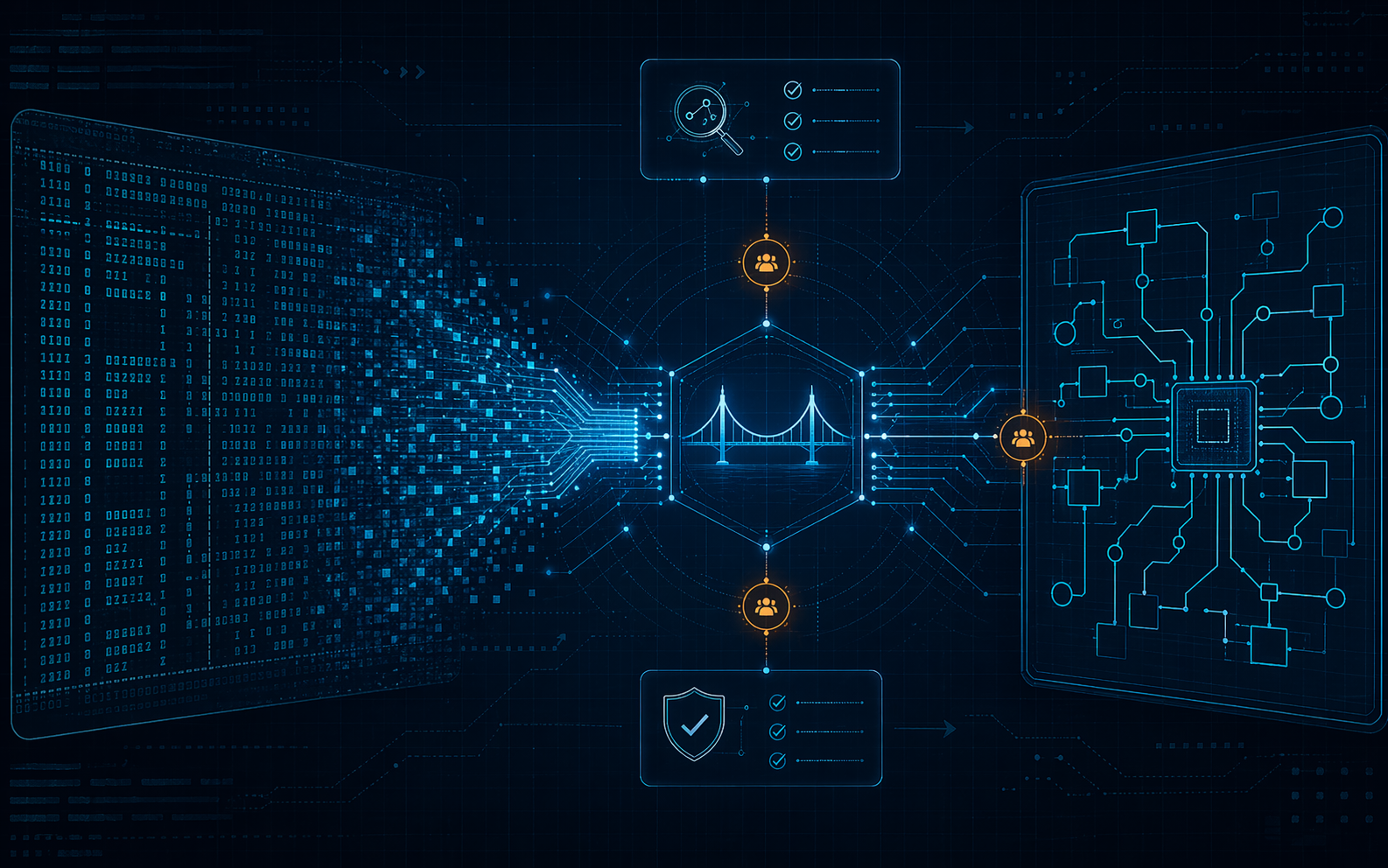
His proposed solution is autoformalization, using semantic embedding spaces to bridge informal human reasoning and formal mathematical proof. The concept is elegant: let the AI's intuition guide the search, then verify the result formally. Preserve the creative leap, but land on solid ground.
But there is a fundamental problem. Circularity.
When an AI generates code and then generates the tests for that code, who verified the verifier? When an AI produces a formal proof sketch and another AI checks it, you have two intuition machines agreeing with each other. That is not verification. That is consensus. And consensus among unreliable agents is not the same as correctness. It never will be.
Perez has identified exactly the right problem. But the solution he proposes still lives inside the same system it is trying to verify. The intuition checks itself. That is like asking a surgeon to grade their own exam. No matter how skilled the surgeon, the conflict of interest is structural.
Intuition Needs Bones
Consider a pilot with thirty years of experience. Their intuition is extraordinary, they can feel turbulence patterns before instruments register them, sense mechanical anomalies from the subtlest vibration, make split-second decisions that save hundreds of lives. Nobody questions the value of that intuition.
But no airline on Earth lets a pilot fly without TCAS, the Traffic Collision Avoidance System. No matter how experienced the pilot is, when TCAS says "DESCEND NOW," the pilot descends. The system does not debate. It does not negotiate. It does not care about the pilot's thirty years of experience. It overrides.
The same principle applies to every car on the road. ABS does not care about your driving skills. ESC does not ask if you meant to oversteer. These systems exist because intuition, no matter how refined, no matter how experienced, operates on incomplete information and is subject to failure modes that the intuitive agent cannot predict or even perceive.
Even the human body follows this architecture. The brain is creative, adaptive, brilliantly intuitive. But it sits inside a skeleton that constrains its range of motion. Bones do not think. They do not need to. They prevent the body from moving in ways that would destroy itself. The brain proposes. The bones constrain.
Intuition is the most powerful cognitive tool we have ever encountered, in humans or in machines. But it needs structure that it cannot override. That is not a limitation. That is what makes it safe.
Software built by intuitive AI agents has the exact same problem. The generation is impressive. The fluency is genuinely remarkable. But without an independent structural layer that certifies correctness, without bones, the system is a brain floating in space. Capable of anything. Constrained by nothing. And that is terrifying.
The Circuit Layer
This is where Digital Circuitality enters the picture, not as a replacement for artificial intuition, but as the bones it has always needed.
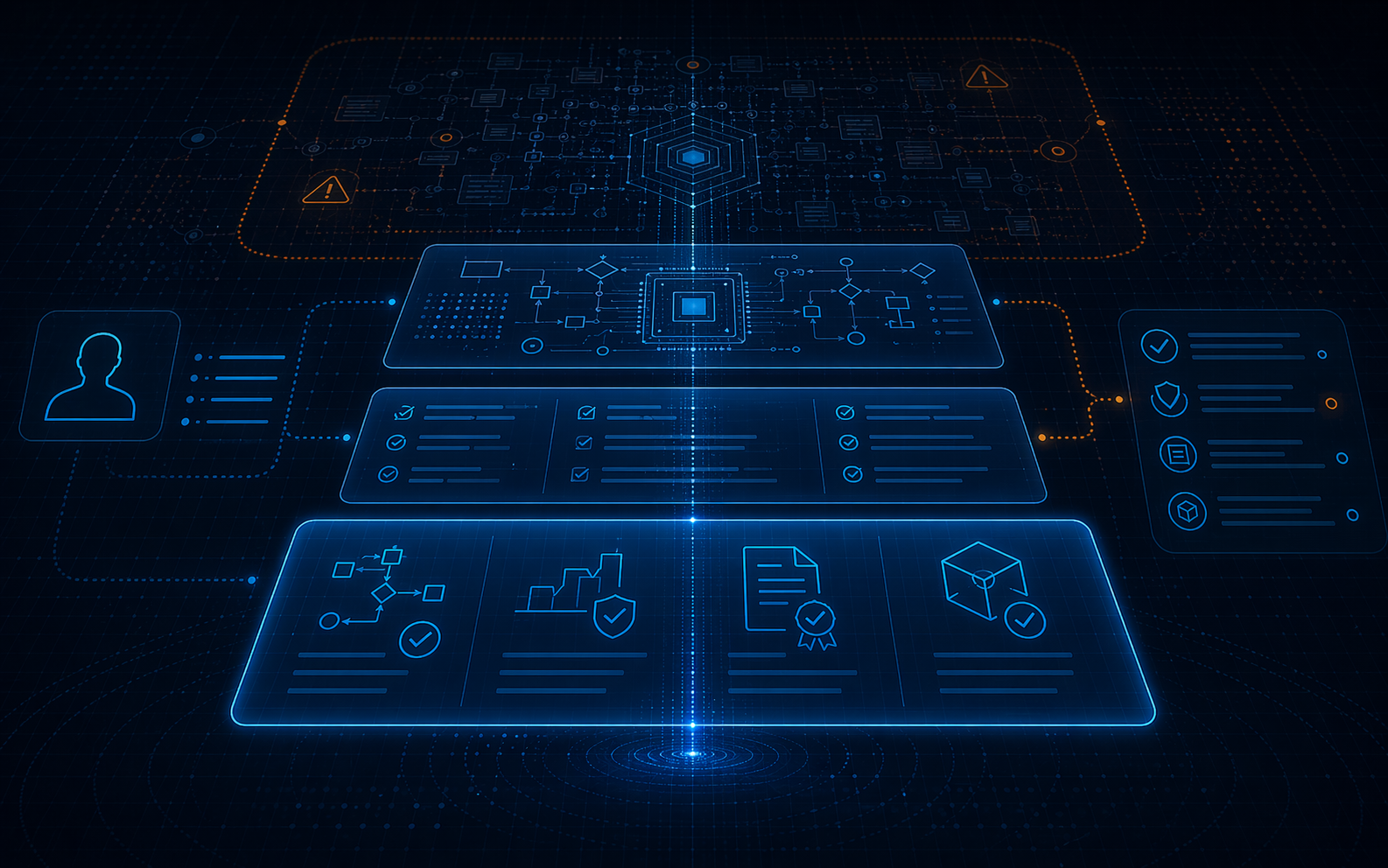
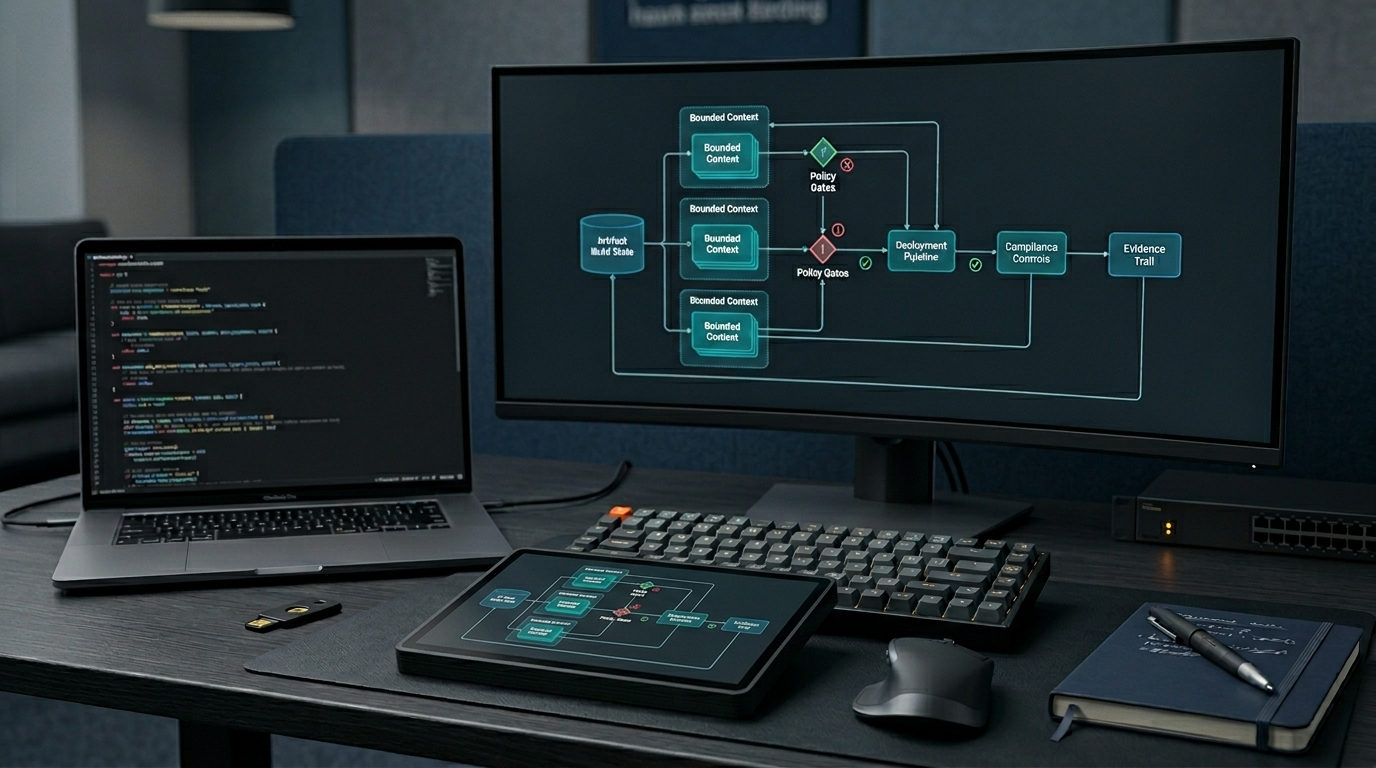
Digital Circuitality treats software the way hardware has always worked: a finite set of review-scoped atomic operations, monomers, composed through algebraic laws, EVA algebra, review-scoped by an independent engine, the TCE, that measures informational closure. When a program achieves closure check passed, the circuit is closed. Every input maps deterministically to an output. Zero information leakage. Zero ambiguity. Zero "it depends."
The key insight is the finite space. An LLM can generate any program in supported targets, an infinite space where verification is undecidable. But when that program is analyzed by the BRIK64 Lifter, it maps onto a bounded set of 64 core operations. In a finite space, exhaustive verification becomes possible.
What the Lifter maps to core monomers gets review-scoped with closure check passed, deterministic, proven, permanent. What maps to extended monomers gets a CONTRACT score, trusted by agreement, declared honestly. What cannot be mapped at all stays outside the review-scoped boundary, clearly flagged as unverifiable. Complete transparency. No hand-waving.
The LLM intuits. The circuit certifies. These are fundamentally different operations performed by fundamentally different systems with fundamentally different guarantees. The certification does not depend on the generator's opinion of its own work. It does not care if the code was written by a human, by GPT, by Claude, or by a random number generator. It depends on algebraic properties that hold regardless of how the code was produced.
This is what breaks the circularity that Perez's autoformalization cannot escape. The verifier is not another AI. It is not another intuition machine agreeing with the first one. It is a mathematical structure. And mathematical structures do not have opinions. They have proofs.
Two Layers, One System
The intellectual frameworks of Carlos E. Perez and Digital Circuitality are not competing. They are not even in the same arena. They describe different layers of the same system, and they need each other.
Layer 1: Generation. This is Perez's domain, and it is extraordinary. LLMs operate with artificial intuition: pattern completion, creative leaps, fluent production at superhuman speed. QPT's four cognitive modes describe how these systems think, or approximate thinking. The Fluency axis generates code, text, decisions. The Empathy axis, when it arrives, will model consequences and stakeholder impact. This layer is powerful. It is creative. And it is fundamentally, structurally unreliable.
Layer 2: Certification. This is Digital Circuitality's domain. A finite algebra of review-scoped operations. An independent coherence engine. Hardware enforcement through the BPU that cannot be bypassed, negotiated, or jailbroken, not by software, not by the AI, not by anyone. This layer is rigid. It is deterministic. And it is fundamentally, structurally trustworthy.
RLHF teaches an AI to want to do the right thing. Policy circuits prevent it from doing the wrong thing. Education fails every day. Physics does not. That is the difference between Layer 1 and Layer 2.
The two-layer model resolves a tension that neither side can address alone. Pure intuition without verification produces impressive but untrustworthy output, the verification gap that costs $2.41 trillion annually in software failures. Pure verification without intuition produces correct but trivial programs, nobody wants to write everything in a 64-operation algebra by hand. You need both.
Together, they form something that has never existed before: a system where AI generates ambitiously and structure certifies rigorously. The creative power of intuition, bounded by the bounded review evidence of circuitry. The brain inside the skeleton. The pilot with TCAS. The future of safe AI.
The Debt We Owe
Digital Circuitality did not emerge in a vacuum, and intellectual debts should be paid in public. Perez's Quaternion Process Theory helped shape this architecture in ways that deserve full acknowledgment.
It was QPT's insistence on the Fluency–Empathy axis that clarified what verification alone cannot cover. When we designed the two-tier certification model, CORE (closure check passed, deterministic) and CONTRACT (extended monomers, trusted by agreement), we were drawing a line that QPT had already mapped: the boundary between what can be supported by bounded evidence and what requires a fundamentally different kind of trust.
The decision to separate the decision space from the execution space in BRIK64's policy circuit architecture came directly from engaging with Perez's framework. Empathy operates in the decision space, what should the system do? Which action best serves the user's needs? Determinism operates in the execution space, given a decision, does the implementation produce the correct result? QPT made this distinction legible.
A pilot decides to divert based on intuition and empathy for passengers. TCAS verifies the new altitude is safe. These are not the same operation, they compose. That compositional insight, that safety requires both an intelligent proposer and a rigid verifier working in concert, owes a genuine debt to the cognitive architecture Perez described.
Digital Circuitality provides the bones. Quaternion Process Theory helped us understand what the bones need to hold. And together, they point toward a future where AI is not just powerful, it is trustworthy.
Carlos E. Perez publishes as @IntuitMachine on X, writes at Intuition Machine on Medium, and shares books and research products through Intuition Machine on Gumroad.