Back to Archive
VISIONFoundations

Why a New Format Instead of Another General-Purpose Language

Why BRIK64 introduces PCD as a bounded computational format rather than extending a conventional language with another annotation layer.

2026-03-30T00:00:00.000Z
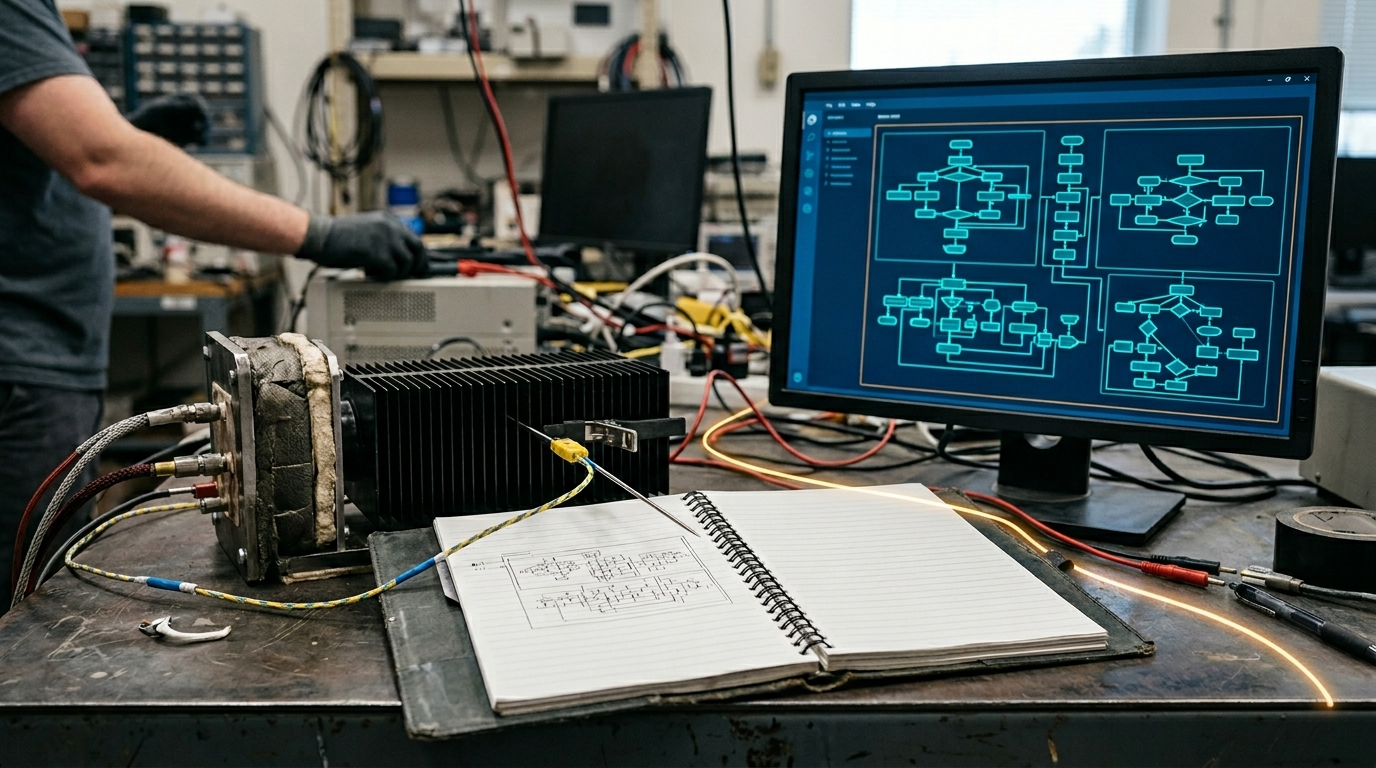
Editorial cover for Why a New Format Instead of Another General-Purpose Language

700 Languages, Zero Guarantees

We have Python, JavaScript, Rust, Go, C, Java, Kotlin, Swift, and literally hundreds more. Every year, someone invents another one. And they all have one thing in common: none of them guarantee that your program is correct.

Rust prevents memory errors. Great. TypeScript prevents type errors. Wonderful. But neither prevents logic errors. Neither guarantees that every input produces a valid output. Neither proves that your algorithm terminates correctly for every possible state. The most important class of bugs — wrong answers — slips right through.

Testing helps. Code review helps. But Dijkstra said it in 1976: “Testing shows the presence of bugs, never their absence.” 50 years later, nothing has changed. We just write more tests and pray harder.

What Would a Correct-by-Construction Language Look Like?

Imagine a language where every function declares its input domain (e.g., range[0, 900]), every branch is exhaustively covered, and the compiler mathematically proves that every execution path produces a valid result. If it cannot prove it, it does not compile. Period.

That is BRIK64. Not a better Python. Not a safer Rust. A fundamentally different approach to what a programming language should be: 128 verified operations (monomers), composed through algebraic laws (EVA), certified by a coherence engine (CMF). Phi C = 1 means every path is closed. The some classes of structural defects can be rejected before runtime. They can be rejected when covered by the model in the output.

The Argument for a New Language

1. AI generates code now. LLMs produce millions of lines of code every single day. None of it is verified. None of it is certified. We need a language where the output of any LLM is automatically, mathematically certified. Not reviewed. Certified.

2. Compliance costs are crushing innovation. MiFID II, SOC2, DO-178C — manual certification costs $1M+ per project. Startups cannot afford it. A language that generates compliance evidence automatically does not just reduce some manual evidence-preparation cost — it democratizes safety.

3. Smart contracts cannot be patched. Blockchain deployments are immutable. Once deployed, a bug is permanent. A language where bugs cannot compile is worth billions in prevented losses. The DAO hack alone was $60M from a single bug.

4. The cost of bugs is measured in human lives. In medical devices, aerospace, autonomous vehicles — a bug can kill. Testing is not enough. Code review is not enough. We need mathematical proof, and we need it to be automatic.

The Pitch

BRIK64 is not competing with Python or Rust. We are not trying to replace your favorite language. We are offering something none of them can: the mathematical guarantee that your program is correct. Write PCD directly, or lift your existing code from 10 languages. Compile to 14 targets — Rust, JS, Python, C, Go, WASM, native x86-64, and more. And get a certificate that mathematically proves correctness.

The world does not need another programming language. It needs the first language where incorrect programs cannot compile. That is BRIK64.


More reading

Continue the archive

Full archive
Technical BRIK64 diagram showing an AI coding prompt transformed into a reviewable blueprint, human review checkpoint, and target outputs.
AI safetyUncategorized

Reviewable AI Coding Pipelines: From Prompt to Blueprint

AI-generated code workflows become more reviewable when teams separate the prompt, generated code, structural blueprint, human review, and target compilation.

Open article
BRIK64 editorial image showing AI-generated software becoming inspectable, certified, and compiled across targets.
AI-generated softwareUncategorized

Making AI-Generated Software Reviewable

AI-generated software can move quickly, but it still needs structure, traceability, and review boundaries. BRIK64 helps teams preserve the blueprint behind generated code.

Open article
Editorial cover for AI Governance Workflows Need Reviewable Technical Evidence
AI SAFETYAI Safety

AI Governance Workflows Need Reviewable Technical Evidence

How bounded software evidence can help teams carry AI governance reviews into compliance workflows without implying full legal coverage.

Open article
Editorial cover for Compiler Evidence: Targets, Proof Files, and Test Scope
ENGINEERINGEngineering

Compiler Evidence: Targets, Proof Files, and Test Scope

A summary of the public numbers that can be stated responsibly and the limits of what those numbers prove.

Open article
Editorial cover for Safety-Critical Software Needs a Readable Assurance Path
PRODUCTProduct

Safety-Critical Software Needs a Readable Assurance Path

How bounded software evidence can support engineering review in high-consequence domains without replacing the broader safety program.

Open article
Editorial cover for Bounded Contract Logic Before Deployment
PRODUCTProduct

Bounded Contract Logic Before Deployment

Why smart contract workflows benefit from explicit state boundaries, value constraints, and reviewable rule sets before deployment.

Open article
Editorial cover for What the Proof Material Means for Users
VISIONFoundations

What the Proof Material Means for Users

A practical note on the proof files behind the compiler and what remains invisible to a normal authoring workflow.

Open article
Editorial cover for Adversarial Testing Against the Compiler Chain
ENGINEERINGEngineering

Adversarial Testing Against the Compiler Chain

How the team tries to break the compiler and what those tests can and cannot prove about the formal system.

Open article
Editorial cover for Translation Validation Across Two Targets
RESEARCHResearch

Translation Validation Across Two Targets

A look at cross-target output comparison, what it can support, and what still depends on the bounded intermediate form.

Open article
Editorial cover for Why Tests Passing Is Not the Same as Closure
VERIFICATIONEngineering

Why Tests Passing Is Not the Same as Closure

A look at sampled testing versus bounded verification, with examples of logic that passed tests but still required stronger structural checks.

Open article
Editorial cover for One Blueprint Across Multiple Targets
PRODUCTProduct

One Blueprint Across Multiple Targets

How the transpilation chain uses PCD as a bounded intermediate form, what 10 source languages and 14 targets mean in practice, and where the equivalence claim stops.

Open article
Editorial cover for What AI Intuition Still Cannot Verify
AI SAFETYAI Safety

What AI Intuition Still Cannot Verify

Why intuition without an external proof path remains a risk, and where BRIK64 fits in that boundary.

Open article
Editorial cover for API and MCP Access Around the Registry
PLATFORMProduct

API and MCP Access Around the Registry

How discover-and-execute workflows expose registry and platform operations to humans and agents without enlarging the proof claim.

Open article
Editorial cover for Blueprints Before Refactors
REVOLUTIONProduct

Blueprints Before Refactors

How extracting bounded computation from an existing codebase can make rewrites and target changes easier to review.

Open article
Editorial cover for A Bounded JavaScript-to-Rust Workflow
TUTORIALGetting Started

A Bounded JavaScript-to-Rust Workflow

Lift the logic, review the bounded blueprint, then emit a target language while keeping the claim attached to the intermediate circuit.

Open article
Editorial cover for Lifting Existing Code into a Reviewable Blueprint
TOOLINGProduct

Lifting Existing Code into a Reviewable Blueprint

What the Lifter preserves, where liftability evidence exists in the repo, and how bounded blueprints help before migration.

Open article
Editorial cover for COBOL Migration Through Bounded Lift-and-Review
MIGRATIONProduct

COBOL Migration Through Bounded Lift-and-Review

Why legacy modernization benefits from lifting review-critical logic into a bounded blueprint before transpilation or replacement.

Open article
Editorial cover for Why AI-Generated Code Needs Blueprints and External Checks
PRODUCTAI Safety

Why AI-Generated Code Needs Blueprints and External Checks

Generated code and generated tests can fail together. This note explains why BRIK64 keeps verification outside the model loop.

Open article
Editorial cover for Which Parts of a Codebase Are Ready for Stronger Review?
PRODUCTProduct

Which Parts of a Codebase Are Ready for Stronger Review?

Use lifting and bounded analysis to identify review-critical functions before migration or certification work.

Open article
Editorial cover for Laszlo B. Kish and the Information-Theory Thread
RESEARCHResearch

Laszlo B. Kish and the Information-Theory Thread

A research profile on the ideas that influenced the information-theoretic framing behind Digital Circuitality.

Open article
Editorial cover for Informational Entropy Is Not Thermal Entropy
RESEARCHResearch

Informational Entropy Is Not Thermal Entropy

Why the distinction matters for the foundations story and how it sharpens the claim boundary around Digital Circuitality.

Open article
Editorial cover for From Preferences to Enforced Action Boundaries
AI SAFETYAI Safety

From Preferences to Enforced Action Boundaries

Why robotics and agent systems need explicit action gates, bounded state, and reviewable fallback paths.

Open article
Editorial cover for First PCD Circuit: A Minimal Walkthrough
TUTORIALGetting Started

First PCD Circuit: A Minimal Walkthrough

Install the CLI, write a small circuit, and inspect the bounded output path. A practical introduction to the format and the compile step.

Open article
Editorial cover for EVA Algebra: Sequence, Parallel, Conditional
DEEP DIVETheory

EVA Algebra: Sequence, Parallel, Conditional

How three composition operators carry sequencing, fan-out, and branching through the circuit model, and what that means for compiler readability and closure.

Open article
Editorial cover for Working with the SDKs Without Leaving the Bounded Model
SDKSGetting Started

Working with the SDKs Without Leaving the Bounded Model

How the Rust, JavaScript, and Python SDKs expose BRIK64 patterns while keeping the formal core distinct from host-language code.

Open article
Editorial cover for Why Software Verification Still Looks Different from Hardware
RESEARCHResearch

Why Software Verification Still Looks Different from Hardware

A comparison between sampled software testing and the compositional review posture hardware teams expect.

Open article
Editorial cover for 128 Operations and the Boundary Between Core and Bridges
ENGINEERINGEngineering

128 Operations and the Boundary Between Core and Bridges

A tour of the reviewed core, the contract-bounded extensions, and what that split means for technical scope.

Open article
Editorial cover for PCD for AI Agents: A Small Format with an External Proof Loop
AI AGENTSAI

PCD for AI Agents: A Small Format with an External Proof Loop

How a finite grammar helps agents author bounded logic while the compiler and policy checks stay outside the model.

Open article
Editorial cover for Precision as a Declared Domain
ENGINEERINGEngineering

Precision as a Declared Domain

Why bounded numeric domains matter for floating behavior, decimal handling, and reviewable arithmetic.

Open article
Editorial cover for BPU: Policy Enforcement as a Hardware Roadmap
HARDWAREHardware

BPU: Policy Enforcement as a Hardware Roadmap

Why software-only guardrails share execution context with the model they constrain, and how the BPU roadmap moves policy enforcement toward FPGA and silicon.

Open article
Editorial cover for Policy Circuits for AI Safety Workflows
AI SAFETYAI Safety

Policy Circuits for AI Safety Workflows

How external policy circuits can gate generated code and agent actions without claiming to solve general alignment.

Open article
Editorial cover for What Digital Circuitality Tries to Formalize
VISIONFoundations

What Digital Circuitality Tries to Formalize

A bounded programming model built from reviewed operations, explicit composition, and closure checks.

Open article